
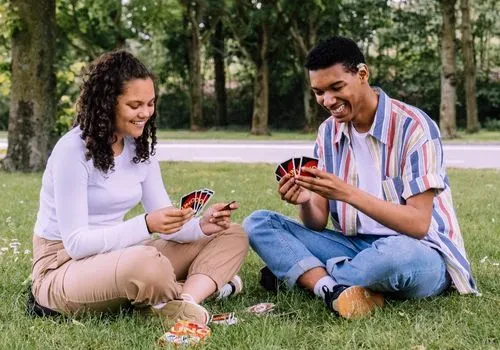

The two-player game is the easiest way to turn a deck of cards into instant fun. No change and almost no setting, you get regular decisions from the first flip to the last point. In this direction, we assemble the best cards for two people on three moods: classical duels, random family picks, and speed or racing, plus part of the two-man match.
You’ll see why each game shines, how long it takes to learn, and who will enjoy it the most. We’ll end with a quick choice and a short online practice idea to help you start tonight.
How We Choose
For two players, the best games teach you rapid flow and keep the decisions interesting. We focus on the choice you can learn in 10–20 minutes, which works with a standard deck of cards (or a set of articles), and that’s the end of a three best game. Delete records, mobile settings, and a lot of rotation value is to have.
- Quick Learning: You can explain in a few minutes.
- Port settings: Ideally, a 52-card deck or a simple subpart (as a pedal or an application).
- Depth without milling: Interesting choices in short sessions.
- The conditions for a clear win: The scratch fits too well.
- Best three: A natural match for weeks and coffee break hours.
Quick Selection: TL; DR
If you want a quick answer, start here.
- Easy night school: War, Eight Mad People, Go Fish
- Best duel: GinRock
- Active Title Text Cribbage
- Best set race: Game 500 (player)
- Best fast reflex game: Speed/ parameter
- Best chaos: Egyptian mouse screw (S)
- Best little puzzle: Golf
- Best override: Two poisons (-Person Solitaure)
- Old gem: Piquet, Bezique, Schnapsen/ Sixty-6.
- Feeling very familiar: 2-Player Spades, 2-Handed Euchre (Three Japan for First Online Practice)
Classic 2 Player Game
GinRock
Gin Rumple is the gold standard for the confrontation game. Each turn, you draw a card and decide whether to keep it or to throw it into the pile, trying to build the patches (set and run) and reduce the dead cards (incompared). You can knock to end your hand once your wood is low, or play for a clean Gon. “It is quick to learn but the reward leaves smart, memory, and time. The study time is 10–15 minutes. Play: 10–20 minutes. For: Careful fighting hand-to-hand with many small victories.
Cribbage
The ability to mix cards with a simple board (or application) has tracks. You’re going to score in a time of fighting by making 15 pairs, and running when you and your opponents place the troops. Then you count the last hand and the crib (a secondary hand replacing the ownership of each round). Cribb feels comfortable and strategic: you weigh which cards to hold, which to flip, and how to drive the race. Learning time is ~20 minutes.
Rooney 500 (2-player)
In Rixton 500, the wires grow through the turns, and you can pick them up from the pile, sometimes losing a long stack to get a card you really need. That push button creates stress and renewable potential. All the issues were abandoned, and the swing score with a brave victory. You can learn the Rhyx language for 10–15 minutes.
LADDER – sout
Piquet uses a 32-card deck (off 2–6 from a standard deck of cards) and blends out/re pulls the decision by statement and the trick game. You’ll name the suit strong and sequence for the score before you finish the hand. It is elegant and stable, with depth revealing a few similarities. The study period was 20–30 minutes, mainly for veteran strategyaries who preferred careful planning.
Bezique (class)
Bezque also uses the piquet (often two) decks and combines regroups (the marriages, the names of familiarness) with deceptive points. It initially appeared exciting, but it flashed quickly and brought a satisfying tone of subsequent release. You can learn it in 25–35 minutes, and it’s for fans of hybrids who are associated with a traditional spell.
Select & Regular Friends
The screen has been closedName
This is the easiest way to fight. You’re setting up cards for suit or rank, and eight is wild. Family Principle: Like “skip” or “draw Two” on certain levels while keeping it alive without adding more complex. You can learn it in 5–10 minutes, and it’s always fun because the variables and twists quickly keep both players involved.
Go Fish (play)
A perfect start for children and a warm choice for adults who want a slight speed. Ask for a lineup, pick up the set, and read your opponent’s request form. It’s simple, visual, and wonderful for the learning suit and ranks. Learn: 5 minutes · Fun because: “Aha! “When you finish a film that never ages.
Old passenger (or play)
Lie softly and laugh a lot. You pull a card from your opponent, try to stay away from the single old lady. It is a fun way to present appropriate and deceptive introductions without pressure. Find out: 5–10 minutes · Fun because: the thrill creates nature when the hand shrinks.
War.
War hardly needs an explanation: flip, compare, and those with higher cards win. It’s lucky, that makes it a first good disturbance with children or a time killer when you just want to play. Find out: 1 minute · Fun because: 0 on the head, just stir and go.
Trashcan (a.k.a. retrieves 2)
You race to build a line of slot numbers (1–10) by flipping and trading the card in the right place. It was fast, satisfying, and ideal for the match again quickly. Find out: 5–10 minutes* Fun because: each flip can fix your board or set a clean finish.
Speed racing game for two
Speed
If you want adrenaline, it starts here. Both players flip and play at the same time, trying to drop the cards by building the sequences increasing or reducing on the co-husband. Rules are easy; joy is about focus and reflex. It was the perfect launch before a strategy game.
Egyptian mouse screw (S)
AS is a slap game: certain samples appear (as doubles), and whoever slaps first grabs the husband. It’s chaotic in a good way, with just enough strategy so it doesn’t become random. It begins quickly if someone loses his husband, which makes the study shorter and dynamic.
Golf (Game, 2 players)
In golf, your goal is to end with the lowest point on several laps. You’re going to flip, exchange, and look at the paper to clean the grid and reduce the total, with small risks that sometimes bring great profit. It’s easy to teach and surprising when you start to track small improvements from circles to circles.
Textcompletion
Two poisons (-Person Solitaure)
This is the confrontation with boxing, both players building platforms from their own cheerleaders as fast as they can, running to clarify the previous article. Because goals are symmetric and without direct interference, it is purely focused, perfectly for friendly competition where the deck is the only opponent.
Stay in the Castle / 40 Thief (as a race)
Many patience games can become a great two-player race. Set mirrors or agree on common rules, start a timer, and see who increases the background in a fixed window. These formats test recognition and sequence under light pressure and feel surprisingly competitive without adding rules.
Online Practice: Start with the familiar classic text
Warm the card senses with a quick browser game. Two or three short laps by Spades or Euchre sharpens lead, counting, and the game ends reading, the precise instinct that the power of the two players fits.
After restarting, select a top table on this list and play 3 points at home. Keep each hand on purpose, keep one and one to fix, and you’ll feel your decision tightened quickly. Next time there’s a problem, the deal’s different.
You want to practice hide-and-seek skills instead of playing two players? Start a quick game in your browser now!