
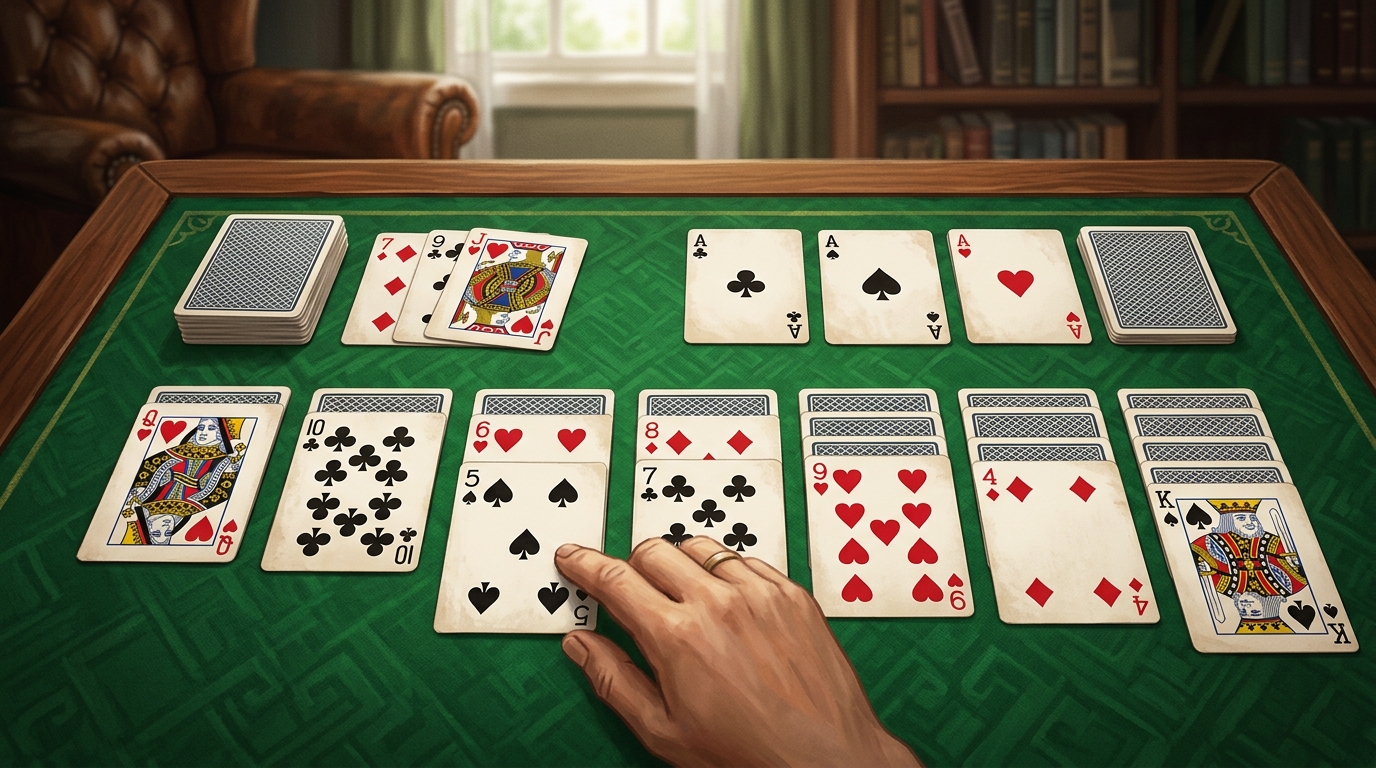
When you sit down to play free solitaire online, watching 52 cards cascade across a virtual green felt table, you are tapping into a cultural legacy that bridges wild 19th-century frontiers and the dawn of modern computing. What we casually refer to today as “classic solitaire” has lived two distinct lives: first as a gritty survival pastime among prospectors in the frozen Canadian wilderness, and later as the secret Trojan horse that taught the world how to use a personal computer.
The Klondike Gold Rush and the Frozen Yukon
While solo card games—known as Patience across Europe—had been played in royal courts since the late 1700s, the specific game rules that dominate the world today originated in the late 1890s in the rugged Canadian Yukon territory during the historic Klondike Gold Rush.
Tens of thousands of prospectors stamped into the freezing wilderness of Dawson City, enduring sub-zero winters in cramped wooden cabins. Trapped indoors for months awaiting the spring thaw, miners passed the endless arctic nights dealing cards into seven stepped columns, striving to build four foundation piles from Ace to King. The game became known simply as Klondike.
As prospectors returned south, they brought the game into New York gaming parlors. Notorious Saratoga Springs casino mogul Richard Canfield adopted a high-stakes version: players bought a deck of cards for $50 and the house paid back $5 for every card successfully transferred to the foundations. If a player ran all 52 cards, they won $500.
1989: Wes Cherry and the Secret Mouse Teacher
Nearly a century later, the game underwent the most consequential digital transformation in entertainment history. In the summer of 1989, Wes Cherry, an unpaid summer intern at Microsoft, was bored in his office in Redmond, Washington. Cherry decided to program a computerized version of Klondike solitaire for the upcoming Windows 3.0 operating system.
Microsoft executives, led by Bill Gates, recognized a brilliant opportunity. In 1990, the personal computer mouse was a revolutionary but intimidating new input device. Most computer users were accustomed to typing text commands on monochrome screens and found mouse coordination clumsy and unnatural.
Microsoft bundled Cherry’s Solitaire into Windows 3.0 with a covert educational mission: it subtly taught users the physical mechanics of the graphical user interface. Clicking on a card taught the left-click; moving a card across the tableau taught drag-and-drop; double-clicking a card to send it to the foundation taught double-clicking. By disguising ergonomics as a beloved card game, Microsoft trained hundreds of millions of people to use modern computers without a single instructional manual.
Susan Kare’s Iconic Bouncing Cards
To celebrate a victorious game, legendary graphic designer Susan Kare—who designed the original Macintosh icons and the deck artwork for Windows Solitaire—programmed the iconic victory cascade: all four suits of cards bouncing rhythmically across the screen, leaving trails of green felt behind them. For millions of workers worldwide, that bouncing deck was the ultimate digital reward.
The Undying Spirit of Solitaire Online
Three decades later, the appeal of free solitaire online remains completely undiminished. While billion-dollar 3D video games come and go, the simple, honest challenge of a 52-card deck continues to reign supreme. It requires no downloads, no complex hardware, and no steep learning curve—just pure, satisfying tactical patience.
Frequently Asked Questions
What is the official name of classic Solitaire?
The traditional game is officially called Klondike. In the UK and Europe, solo card games are collectively referred to as Patience.
Who programmed the original Windows Solitaire game?
Wes Cherry, an intern at Microsoft, coded the game in 1989, while pioneer pixel artist Susan Kare designed the original card face graphics and the famous bouncing victory animation.
Why was Solitaire originally included with Windows?
It was primarily designed to familiarize new PC users with the computer mouse, specifically teaching the intuitive gestures of pointing, clicking, dragging, and dropping.
Every fresh deal is a new puzzle waiting to be unraveled. Take a relaxing five-minute break from your busy day and enjoy a classic deal of free solitaire online on free-solitaire-online.com right now!