
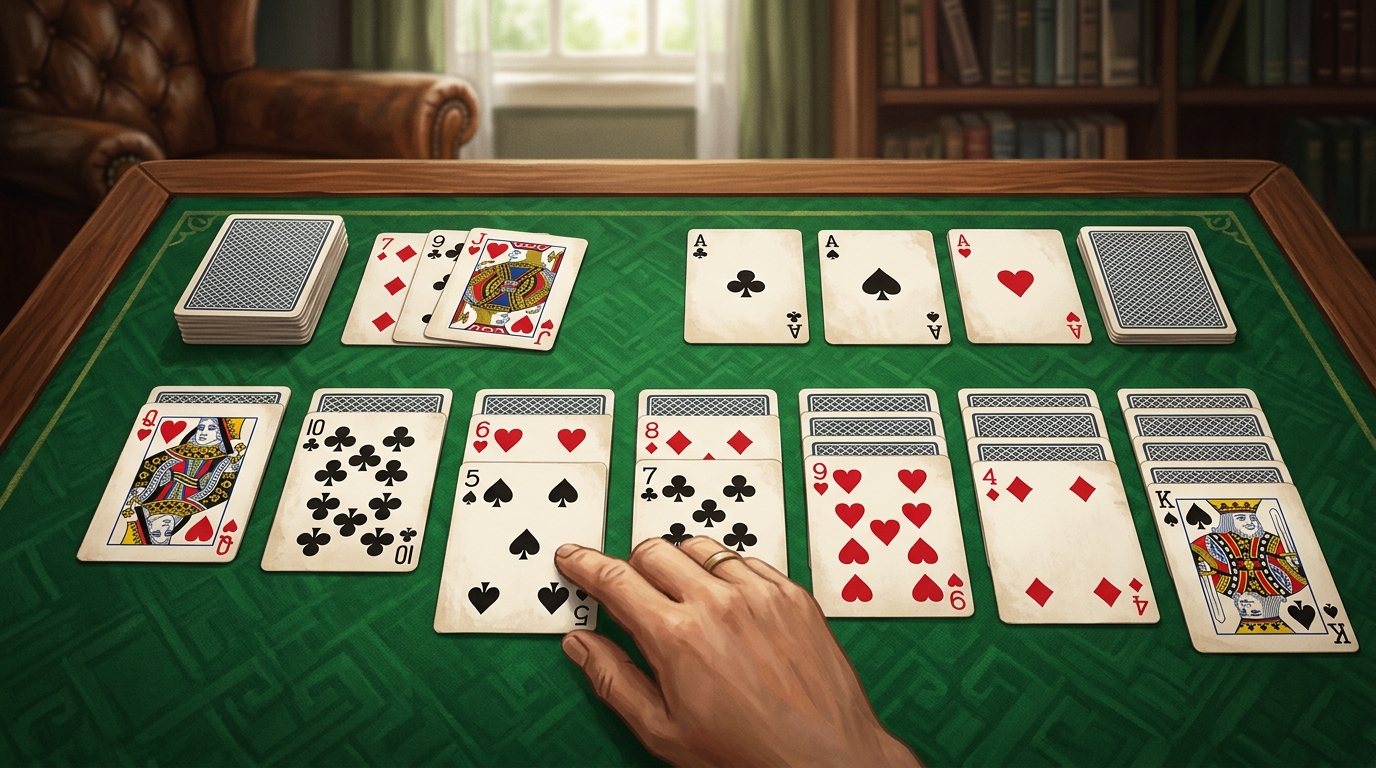
For many players, Solitaire was the first game they learned without buying a game. Solitaire Windows history is part software story, part workplace memory, and part lesson in interface design: the cards taught people how to use a mouse while giving them a reason to keep clicking.
The useful context
Microsoft's account of Solitaire's Windows arrival describes the game's role in making a computer feel approachable. The basic rules were already familiar from patience traditions, but the screen added instant setup, clear movement, and another deal whenever a player wanted one.
For background, read Microsoft's account of Solitaire's Windows history and Bicycle's Klondike Solitaire rules. These sources provide the historical or rules context; the practical advice here is written for ordinary browser play.
Solitaire Windows History
That combination made classic Solitaire unusually durable. The goal is easy to explain, but the tableau still leaves room for planning. A player can use the game as a two-minute break or settle into a longer attempt without changing the rules.
Read the tableau before touching the stock. Look for moves that reveal face-down cards, open a column, or create a useful sequence. The digital interface makes every legal move easy, but a good board still depends on choosing the move that improves the hidden position.
The useful detail in Solitaire Windows history is not a secret trick. It is a way to separate strong evidence from an attractive distraction. That distinction matters because casual puzzle sessions are usually lost through small commitments: one unverified letter, one premature card move, or one piece accepted because it almost fits.
If the first attempt does not work, do not restart immediately. Leave the board in place and name the point where your information became weak. A short explanation is more valuable than a perfect replay. It tells you whether the next session needs a slower opening, a different order, or simply a smaller challenge.
The common trap
The common mistake is assuming a familiar game needs no strategy. Sending cards to the foundation too early, hiding a needed rank, or filling a column without a King can close the board. Familiarity lowers the entry barrier; it does not remove the decisions.
When the board feels crowded, return to the last decision you can prove. A short reset is more useful than adding more moves, more notes, or more guesses. The goal is to make the next choice visible.
A practical routine for today
Use one daily board as a small reading exercise. Spend the first minute identifying the blocked columns, then play only moves that reveal or improve access. If you lose, note the first moment when the tableau became narrow. That is more useful than blaming the final card.
Keep the session small enough to review. One focused board teaches more than a string of rushed attempts, especially when the game is part of a daily break.
This approach also travels well between paper and browser play. On paper, the clue may be a pencil mark, a blank margin, or a small pile of pieces. Online, it may be a highlighted cell, a movable stack, or a saved position. The interface changes, but the question stays the same: what does this move make easier to see?
There is no need to turn a relaxing game into a performance test. A good routine should leave enough attention for noticing, not just finishing. Stop after a useful change, write down what opened, and return later if the board still has a clear question. That is how a narrow technique becomes a repeatable habit.
Keep the game moving
Solitaire Windows history explains why the game remains recognizable across devices. The interface changed, but the quiet appeal stayed the same: a compact problem, a clear goal, and one more chance to read the cards better.
For a live follow-up, play today on this site and browse more daily puzzles on Easy Daily Puzzle.
Keep Solitaire Windows history as a lens, not a rule that overrides everything else. When the board offers a stronger piece of evidence, follow it. The value of a named technique is that it helps you see a better option sooner, then get out of the way when the position asks for something different.
A useful test is to ask whether the position became more open after your move. More open can mean an exposed card, a cleaner crossing, a connected image area, or a smaller list of candidates. If the board became harder to explain, pause before adding another commitment. Good play usually leaves a trace that the next move can follow.
Image suggestion: an editorial illustration with alt text “Solitaire Windows history”.